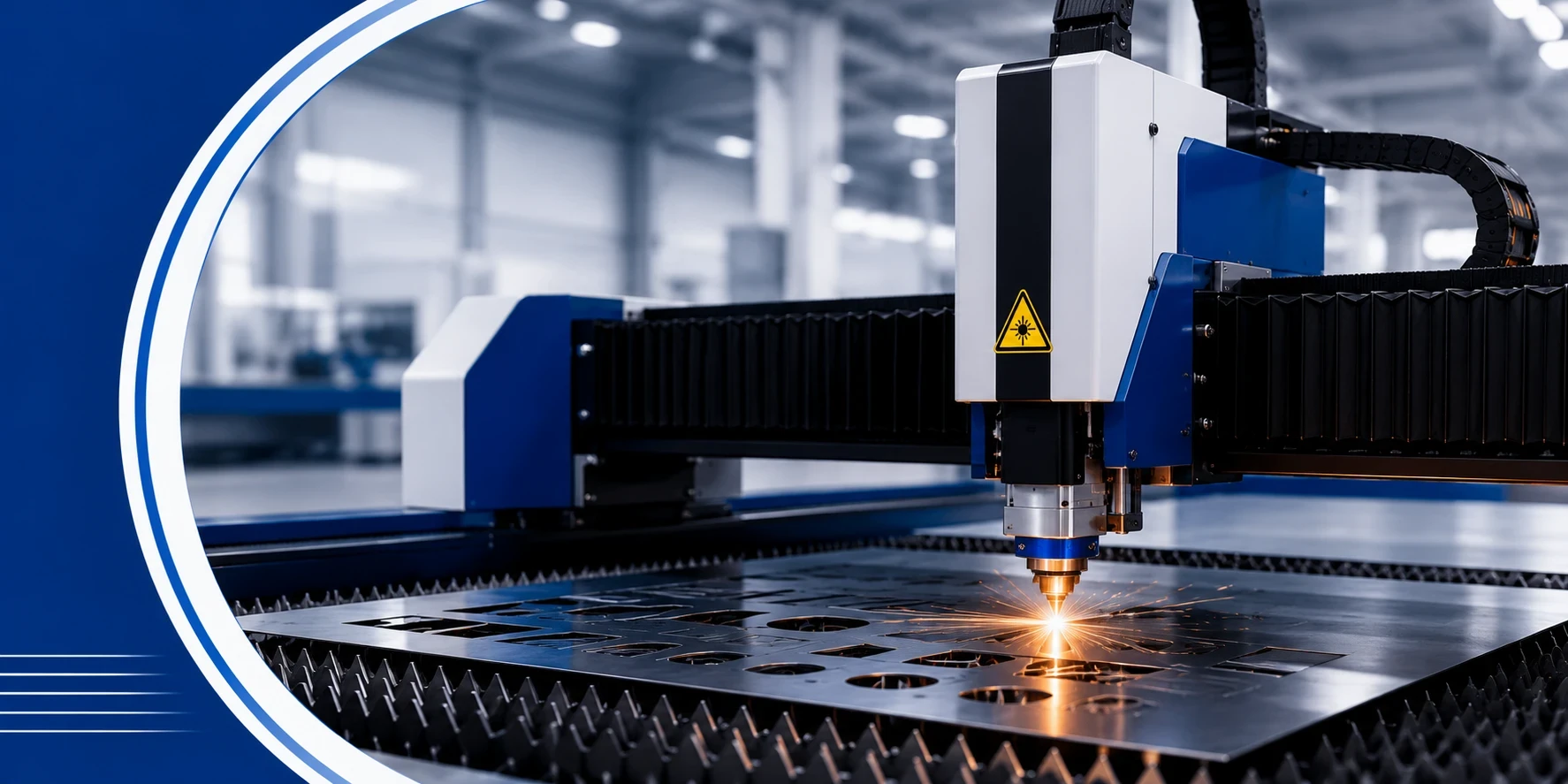
Selecting the right industrial laser cutting system is one of the most critical capital investment decisions for modern metal fabrication workshops, architectural fabricators, and manufacturing plants. In the current industrial landscape, fiber laser cutting machines and CO2 laser cutting machines represent the two dominant technologies. While both utilize concentrated coherent light to sever materials with high precision, their underlying wavelengths, optical transmission mechanisms, electrical efficiencies, and material interactions differ substantially.
At Sky MultiTech Solutions Pvt. Ltd., we manufacture and engineer both advanced CO2 Laser Cutting Machines and precision Fiber Laser Systems. In this guide, our engineering specialists break down the core performance benchmarks, electrical costs, and application domains of each technology to guide your procurement strategy.
The primary physical distinction between fiber and CO2 lasers lies in their operating wavelength:
From an ongoing operational cost perspective, fiber lasers provide superior photoelectric conversion efficiency. Fiber laser sources typically achieve an electrical wall-plug efficiency between 30% and 40%, meaning that substantially less input power is lost as waste heat. Consequently, smaller external water chillers are required, lowering overall factory power consumption.
In contrast, standard CO2 laser tubes deliver an electrical conversion efficiency between 10% and 15%. Because more input power converts into thermal dissipation, higher cooling capacity is needed, and consumable optical mirrors require regular inspection, cleaning, and periodic realignment to maintain consistent cut quality.
Material compatibility is often the decisive factor when choosing between the two systems:
While the initial purchase cost of a high-power industrial fiber laser system is traditionally higher than that of an equivalent-bed-size CO2 cutter, fiber lasers feature a virtually maintenance-free solid-state oscillator with an MTBF (Mean Time Between Failures) exceeding 100,000 working hours. CO2 laser systems, while significantly more economical in initial capital outlay, require periodic laser tube replacements and mirror maintenance every 6,000 to 10,000 operational hours.
The choice between a fiber laser and a CO2 laser cutter ultimately hinges on your facility's core materials, expected daily cut volumes, and return on investment targets. For dedicated sheet metal cutting, fiber laser technology offers unbeatable speed and lower cost per part. For versatile multi-substrate workshops working with plastics, woods, and textiles, CO2 technology remains the undisputed industry standard.
As a leading Indian machinery manufacturer, Sky MultiTech Solutions Pvt. Ltd. provides comprehensive technical consultations, material test cuts, and turnkey machinery setups tailored to your production volume. Contact our engineering team at [email protected] or call +91-7290073759 to schedule a live demonstration or receive an expert machine recommendation.